
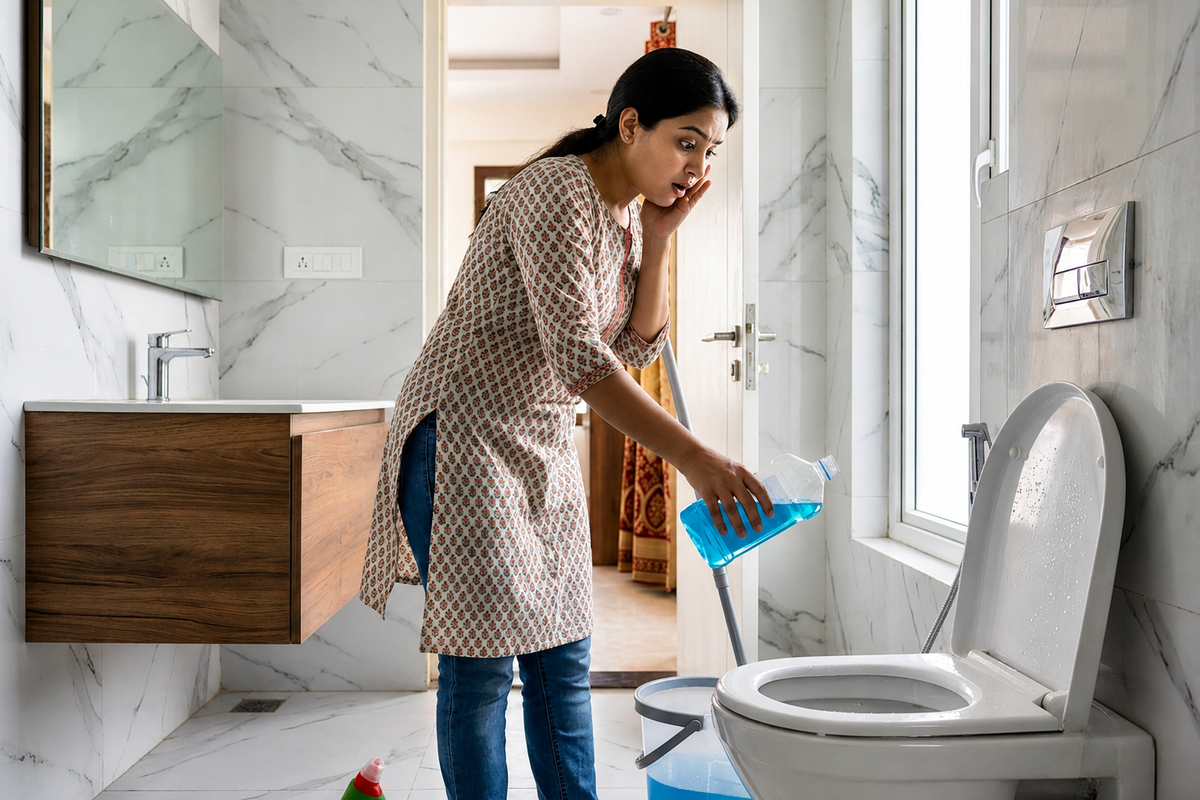
It was one of those days - I’d run out of toilet cleaner, my floor cleaner was sitting right there under the sink, and I figured: it’s a cleaner, it’s a bathroom, close enough. It wasn’t close enough. The toilet bowl looked fine on the surface, but the stains around the waterline barely budged, and I later found out I’d been lucky - using the wrong cleaner in a toilet bowl can go a lot worse than “it just didn’t work.”
Why floor cleaners and toilet cleaners aren’t interchangeable
The difference comes down to what each product is chemically built to fight.
Floor cleaners are formulated to lift dust, everyday dirt, and light grease off a surface you walk on - usually with a neutral to mildly alkaline pH, safe for repeated skin contact and multiple surface types.
Toilet cleaners are built to break down mineral deposits, limescale, and hard water rings inside a bowl - which usually means a much more acidic formulation. Toilet bowl cleaners typically sit around pH 1–3, making them highly acidic, while products like chlorine bleach sit at the other end around pH 11–13. Floor cleaners are nowhere near either extreme, which is exactly why they don’t dissolve limescale - and exactly why toilet cleaners aren’t safe on your floor.
What actually happens when you swap them
Using floor cleaner in the toilet: it won’t damage anything, but it also won’t touch mineral stains or limescale the way a toilet cleaner is built to. You’ll be scrubbing a lot harder for a result that still looks incomplete.
Using toilet cleaner on your floor is the riskier swap. Toilet cleaners rely on high concentrations of acids like hydrochloric acid and bleach-based compounds to cut through stains and odours, while bathroom and floor cleaners use milder, all-purpose formulations meant for tiles, sinks, and showers. Long-term exposure to these stronger acids can discolour tiles and degrade grout over time - the kind of damage that doesn’t show up after one use, but does after a few months of habit.
There’s also a safety angle worth knowing: inhaling fumes from acidic toilet cleaners can be genuinely harmful, which is part of why they’re formulated for a specific, contained use case rather than open surfaces.
So what should actually be in your bathroom cabinet?
You don’t need five different products, but you do need at least two:
1. A floor cleaner for tiles, safe for daily use and skin contact
2. A dedicated toilet cleaner for the bowl, built to handle limescale and mineral buildup specifically
If you want to simplify further, look for a toilet cleaner that's still formulated without harsh bleach or hydrochloric acid concentrations - plant-based, acid-balanced options exist that do the job without the fumes or the grout damage risk. That's basically what I ended up doing - one bottle stayed by the sink for the tiles, and a different one, made specifically for limescale and hard water stains, stayed by the toilet. No more grabbing whatever was closest and hoping for the best.
It sounds like a small change, but it's the difference between guessing and actually knowing what's in your hand. The lesson from my own 'close enough' moment: convenience is not the same as compatibility. Keep the right cleaner in the right hand.

Leave a comment
This site is protected by hCaptcha and the hCaptcha Privacy Policy and Terms of Service apply.