
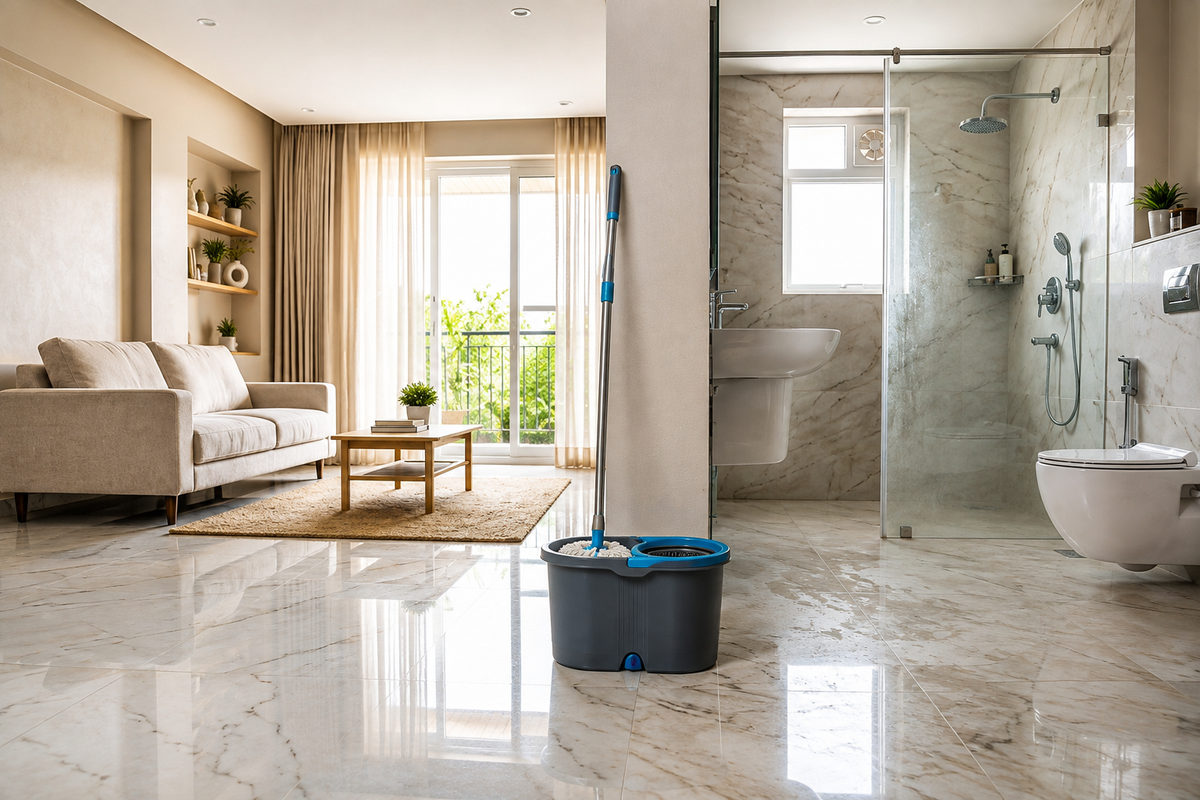
For almost a year, I mopped my entire house - bedroom, hall, kitchen, bathroom - with the exact same bottle. It made sense in my head: it’s a floor, and it's cleaner, so why complicate it?
Then I noticed something my regular floor cleaner just wasn’t fixing: a faint musty smell near the bathroom drain, and a slight slip-when-wet feeling on the tiles even after mopping. That’s when I actually looked into what my bathroom floor was dealing with that no other floor in my house was - and it changed how I cleaned completely.
Your bathroom floor has a different job to do
Every other floor in your home deals with dust, foot traffic, and the occasional spill. Your bathroom floor deals with:
• Constant moisture - which is exactly what mould, mildew, and fungus need to grow
• Soap and shampoo scum - a filmy residue that regular floor cleaners aren’t built to cut through
• Hard water and limescale deposits - especially common in most Indian cities
• Higher bacterial load - simply from proximity to the toilet and shower drain
A general floor cleaner is usually formulated to handle dust and light dirt on dry surfaces. It’s not necessarily built to fight fungal growth or break down soap film - which is why your bathroom floor can look “clean” right after mopping and still smell off within a day.
How to tell if you need to switch
Ask yourself:
• Does my bathroom floor smell musty within a day of mopping, even though it looks clean?
• Is there a persistent grey or yellowish or pink tinge near the drain or corners?
• Does the floor feel slightly slippery even after it’s dried?
If you answered yes to any of these, it’s not a mopping-frequency problem - it’s a formulation mismatch.
What to actually look for in a bathroom floor cleaner
• A formula that specifically mentions soap scum or limescale removal.
• Safe to use on wet, non-slip, and glazed bathroom tile types.
• Ideally, a plant-based or non-toxic formulation, since bathroom floors are high-contact for bare feet.
That's really the whole point - my bathroom wasn't asking for a stronger cleaner, it was asking for the right one. Kleenest's bathroom cleaner is plant-based and zero-bleach, with no ammonia or parabens, built to break down soap scum and limescale in the same wipe instead of needing two different products for two different problems. It works across tiles, taps, glass, and fittings without scratching or streaking, and there's no harsh chemical smell left behind - just a bathroom that's actually clean, not just fragranced. One dedicated formula, one room, no compromises


Leave a comment
This site is protected by hCaptcha and the hCaptcha Privacy Policy and Terms of Service apply.